NATO Secretary General Jens Stoltenberg said at the summit’s end that although Ukraine will not immediately become part of NATO because of the ongoing war, there will be a path for it to join afterward as a broader message to Russia. Member nations also pledged to send more cruise missiles to Ukraine and to begin training of Ukrainian F-16 pilots within Romania.
“What we do know is that the more military support we provide to Ukraine, the more land they are able to liberate, the stronger their hand will be at the negotiating table,” Stoltenberg said.
During the Air Defender event, Russia took notice. U.S. Air National Guard Director Lt. Gen. Michael Loh says participating aircraft saw Russia watching from the air on the eastern edge of the exercise, prompting the NATO nations to adjust how they flew to avoid showing all their capabilities.

About 200 aircraft operated together across Europe for more than two weeks during Air Defender. The scenarios were designed to practice all phases of a potential conflict, starting with large-scale deployments from the U.S. It featured the largest airlift from the U.S. since the beginning of the Iraq War.
Aircraft practiced establishing air superiority with the destruction of long- and medium-range surface-to-air missiles (SAM). U.S. participating aircraft included A-10s, Lockheed C-130s, Boeing F-15s, Lockheed Martin F-16s and F-35s, Boeing KC-135s and KC-46s and General Atomics MQ-9s. German participants included Eurofighter Typhoons, Panavia Tornados and Airbus A400Ms. Hungarian Saab Gripens, Greek F-16s, Finnish Boeing F/A-18s, Spanish F-18s and Turkish F-16s also participated, among others.
During a visit by senior-level NATO military members in the later days of the exercise, Aviation Week observed a briefing of a specific scenario. Friendly “blue” forces of F-35s and Eurofighter Typhoons targeted SAMs from afar over the North Sea. Follow-on fighters—including F-16s, Gripens and A-10s—then came in to target smaller, mobile SAMs. Joint terminal attack controllers and special operations forces on the ground located and followed the mobile SAMs, providing new targeting information for the aircraft.
“Red” enemy aircraft played the roles of Sukhoi Su-24s and Su-30s, with simulated SA-11s and SA-15 SAMs on the ground. Additionally, aircraft defended against a simulated long-range bomber strike, with a Typhoon dropping to a low level to mimic a cruise missile, Loh says.
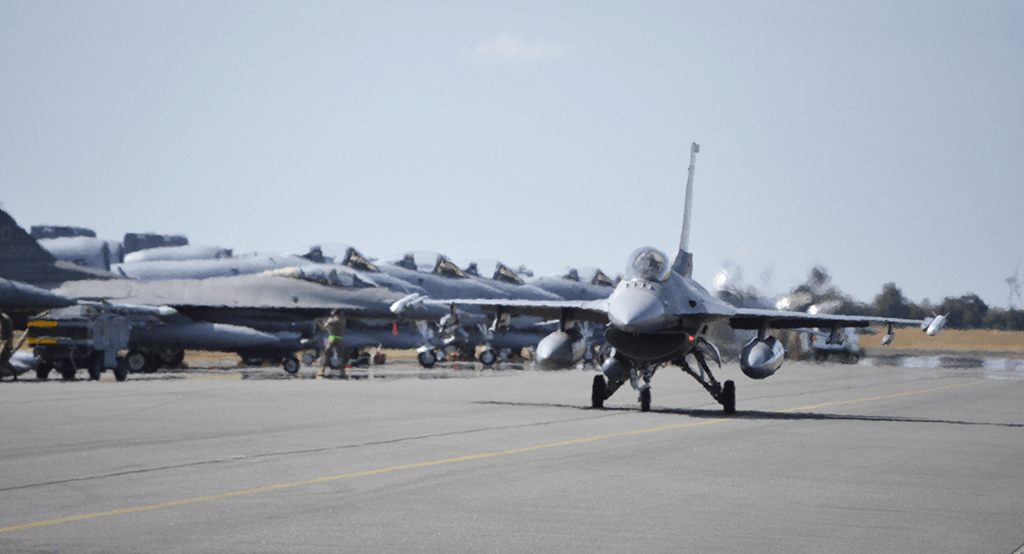
The massive deployment of Air National Guard aircraft comes as the U.S. Air Force and Capitol Hill debate the future of the fleet. The service is continuing a “divest to invest” plan, aiming to fully retire A-10s, F-15C/Ds and about half of the F-15E fleet. Most of the A-10s and F-15s are flown by the Air National Guard.
Loh says he is concerned about the future of his fleet, pointing out that any additional funding the guard receives would need to go directly to fighter modernization. This would mean the guard should be given aircraft fresh off the production line, he says, likely more F-15EXs.
“You can see that capacity’s an issue when you put together a large force package to go out there and execute. Numbers matter,” he says. “So the ability to put fifth-gen, fourth-gen—the F-15EX is a lot closer to a fifth-gen fighter with its capabilities than it is a fourth-gen—the ability to put those modern assets on the battlefield will definitely pay huge dividends.”
The Air Force is in the early stages of bringing F-15EXs on board. The planned buy changed with each budget request during the previous few years. The latest request calls for purchasing 104 of the aircraft. The service plans to combine F-15E and F-15EX training after the Air National Guard closes down the F-15C/D schoolhouse training unit in Klamath Falls, Oregon. Loh says this puts the guard in a bit of a bind, since the F-15E training focuses largely on the Strike Eagle’s ground strike role while the guard needs its F-15EX fleet to focus on air superiority for homeland defense.
“The pilots here in the National Guard, will be focused on air-to-air [and] air superiority,” he said during the guard’s largest air exercise in Germany, which included aging F-15Cs set to be replaced by -EXs. “That’s what I really need them to focus on.”
The Air Defender exercises in Germany came more than a year after Chancellor Olaf Scholz announced plans for a large increase in the country’s defense spending beyond NATO’s 2% goal. Before the announcement, Germany was spending approximately 1.5% of its GDP on defense. Much of the promised increase has yet to come to fruition, with major plans announced but not appropriated. This includes the F-35 buy and a new Berlin-led air defense effort called the European Sky Shield Initiative.
In February, Scholz said Germany had been neglecting the German Armed Forces and that he wanted to reverse that with a special fund of €100 billion for the military spurred by a change in the country’s constitution. Critics have said the government has been moving too slowly on that plan. Among them is Michael Schoellhorn, CEO of Airbus Defense and Space, who says the company has not received any orders and that its A400M is being held back by export restrictions.
In addition to F-35s, the fund is expected to support procurement of more helicopters and maritime patrol aircraft.
 AEROSPACE and ASTRONAUTICS